
Organisational partnerships
Delivering a worldwide membership programme requires significant resources. You can make the process more streamlined for yourself by working with trusted partners who can slot into different points in the process. The diagram below shows the relationships and membership workflow of the 'standard' implementation of OtF. We would also like to emphasise that it can of course be modified to suit you, based on capabilities and agreements you may already have or prefer. For example, for backlist package hosting and activation, while Project MUSE are in the diagram and provide these services for both CEU Press and Michigan State University Press, this is not a universal rule. Liverpool UP don't use Project MUSE to host their backlist as they have their own LUP platform, Boydell & Brewer work with Fulcrum in this capacity, and Basler Afrika Bibliographien work with the African Books Collective.
Diagram of the membership sign up workflow and relationships
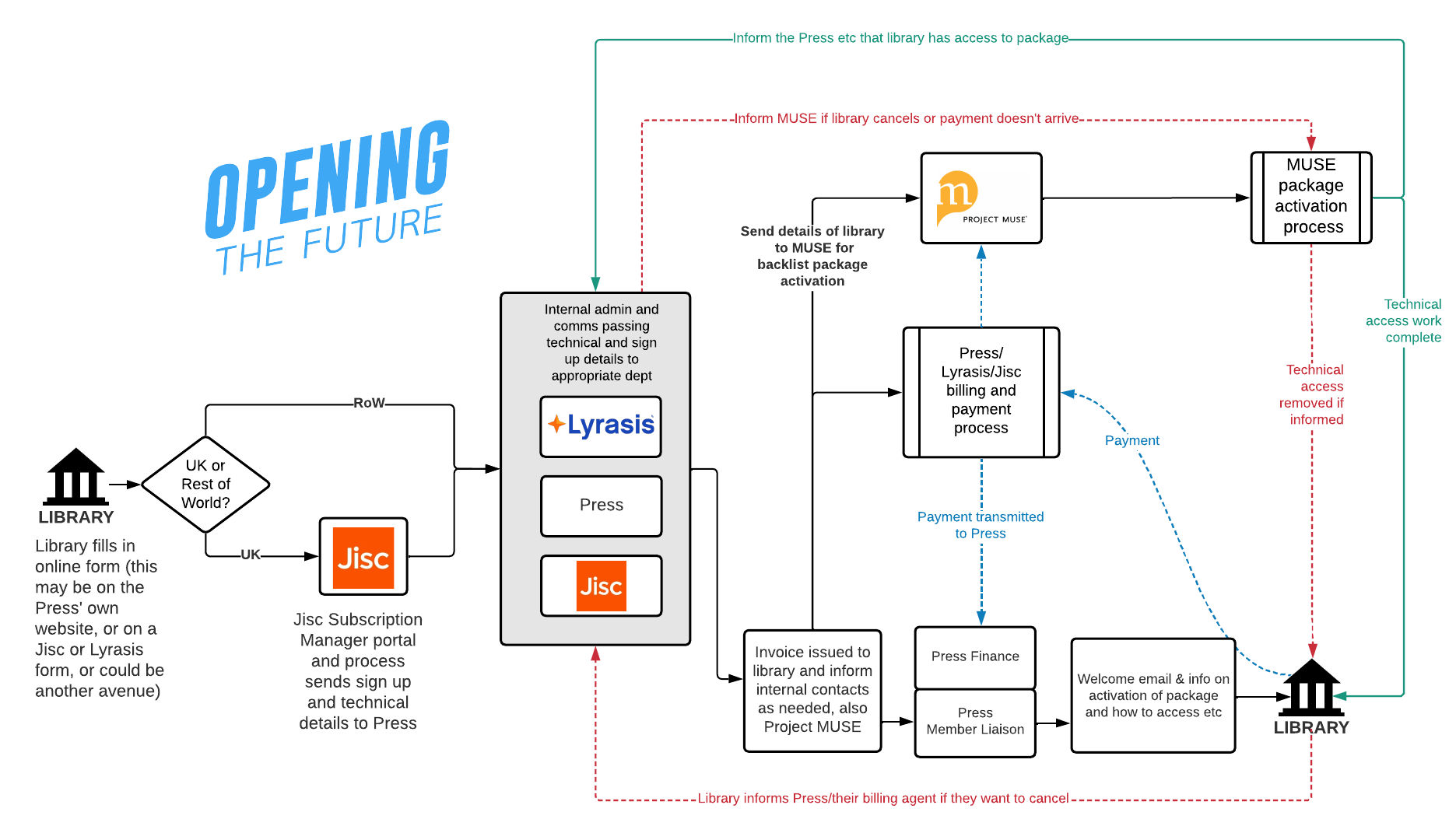
Explanation of the steps in the diagram
The attached short document describes in more detail the various steps highlighted in the diagram. Download the Word document here 👉 Generic OtF billing & package activation access process steps_Feb_2025.docx
Important partners in the workflow of the model
Below we list the partnerships that we developed for Opening the Future, their role in the delivery, pricing, and their contact details.
1. Billing and sales partnerships
Listing your OtF offering with Lyrasis and Jisc is extremely important, as they are highly experienced in organising the sign up and billing of these sorts of agreements between publishers and libraries in the US and UK respectively, where many supporting libraries are based. It is also an indicator of trustworthiness for the libraries to be hosted on these platforms.
Lyrasis
Lyrasis is a non-profit membership organization that catalyzes and enables equitable access to the world’s knowledge and cultural heritage. Lyrasis helps its members succeed by working with them to identify their needs, issues and challenges, and by providing products, services and learning experiences to address them. Lyrasis provides leadership in, and opportunities for, innovation and sustainability and in facilitating their members' pursuit of a preferred future.
Lyrasis has long been a supporter of membership-based open access models in North America. It is also usually already setup as a supplier in many North American institutional systems, thereby substantially lessening the overhead of payment processing for most presses.
Lyrasis charges a percentage transaction fee, which can be included in the financial modelling spreadsheet found elsewhere in this toolkit.
Contact: Sharla Lair, Senior Strategist, Open Access & Scholarly Communication Initiatives (sharla.lair@lyrasis.org)
Jisc
Jisc
Jisc works on behalf of its members and customers in the United Kingdom, to negotiate and license the high-quality digital content agreements needed to support academic research, teaching and learning. Its strategic groups set the direction of national-level negotiations.
Jisc is the official intermediary for most content made available to UK libraries. Many UK libraries expect to be able to sign up through Jisc Library Subscription Manager. Jisc has a template license developed in partnership with Copim that can be used quickly to establish new Opening the Future programmes. Jisc levy a 2% transaction fee to publishers per library subscription.
For the Jisc Licensing Template you can download this example copy but note that it will need adapting to your own packages, date ranges and prices etc in discussion with Jisc 👉 Example Jisc Opening the Future Licence & Offer.docx
Contact: Caroline Mackay, Licensing manager (caroline.mackay@jisc.ac.uk)
2. Partnerships for delivering the content
Content delivery is an important component of this model; firstly the delivery of backlist packages to libraries, and secondly ensuring that the frontlist OA titles enabled by the library funding are findable.
Backlist pack delivery
Fulcrum
One option for backlist package hosting is Fulcrum at the University of Michigan. They have provided a range of publishing services to mission-driven publishers since their full launch in 2018, all driven by five core design principles: flexibility, durability, discoverability, accessibility, and integrity.
Fulcrum offer robust metadata provision to participating libraries, many of whom are already using the platform (for library members they offer free MARC records and KBART files, along with COUNTER 5-compliant usage reports). Of particular note, Fulcrum provides the access control for the subscription portions of Opening the Future, thereby avoiding the need for presses to implement their own access control measures (see below on Technical Infrastructure).
They offer library fulfilment, and presentation of publisher lists among many other services, and can work with for-profit publishers. Currently, they work with Boydell & Brewer on their iteration of Opening the Future.
Contact: fulcrum-info@umich.edu
Project MUSE
Project MUSE is a leading provider of digital humanities and social science content for the scholarly community around the world.
For more than 25 years, Project MUSE has been the trusted and reliable source of complete, full- text versions of scholarly journals from many of the world's leading universities and scholarly societies. Currently, Project MUSE has over 700 journals from 125 publishers and offers nearly 70,000 books from more than 140 presses.
Project MUSE offers robust metadata provision to participating libraries, many of whom are already using the platform (for library members they offer free MARC records and KBART files, along with COUNTER 5-compliant usage reports). Of particular note, Project MUSE provides the access control for the subscription portions of Opening the Future, thereby avoiding the need for presses to implement their own access control measures (see below on Technical Infrastructure).
However, it must be noted that Project MUSE can only work with non-profit organisations. Therefore, any commercial publishers wishing to implement OtF will need to find an alternative platform for libraries to access the backlist packages.
Currently, they work with CEU Press and Michigan State University Press on their iteration of Opening the Future.
Contact: Nicole Kendzejeski, Associate Director (MUSE@jh.edu)
The African Books Collective
The African Books Collective was established in 1989 to provide infrastructure for African publishers who were finding it difficult to disseminate their books to buyers and libraries in other regions. Since this time, they have responded to the evolving needs of publishers and now distribute and market eBooks, undertake production work, and provide marketing services. They remain a vital infrastructure for over 150 academic and trade publishers in the region, leveraging economies of scale on their behalf to ensure their eBooks are available on major global platforms.
Participating libraries will be able to access MARC records and KBART files customised to their holdings, and to retrieve COUNTER 5-compliant usage statistics.
Currently, they work with Basler Afrika Bibliographien on their iteration of Opening the Future.
Contact: Stephanie Kitchen, Executive Director (stephanie@africanbookscollective.com)
Sciendo
Another alternative service provider for backlist package hosting is Sciendo, a provider of publishing solutions based in Poland who already undertake library fulfilment services of this kind, and have confirmed they are open to hosting for the OtF scheme in particular.
Contact: Kasia Zasada, Product Manager (Katarzyna.Zasada@sciendo.com)
Ensuring findability of frontlist OA titles
OAPEN & DOAB
OAPEN promotes and supports the transition to open access for academic books by providing open infrastructure services to stakeholders in scholarly communication. They work with publishers to build a quality-controlled collection of open access books and provide services for publishers, libraries, and research funders in the areas of hosting, deposit, quality assurance, dissemination, and digital preservation.
They deposit all books published openly through the Opening the Future scheme in OAPEN to enhance discoverability and use of the open content.
DOAB is a community-driven discovery service that indexes and provides access to scholarly, peer-reviewed open access books and helps users to find trusted open access book publishers.
Contact: Silke Davison, Community Manager (s.davison@oapen.org)
Thoth Open Metadata hosting service
Thoth is an Open Dissemination System for Open Access books, and a fellow work-package on Copim. They are founded on the principle that OA publications are only as good as their metadata – i.e. their findability. They have both free and paid services for metadata creation and dissemination.
It is specifically designed for OA books and consists of:
- An API to export open metadata (CC0) in multiple formats such as ONIX, MARC, etc.
- An easy-to-use front end to manage metadata records.
They also offer Thoth Hosting, which offers seamless, efficient, and globally-optimised solutions for content and website / catalogue hosting to streamline distribution of a publisher's publications, and will also provide open and privacy-respecting usage statistics. If you need a site to host your OA frontlist publications, Thoth Hosting may be a solution but they cannot host the closed backlist content.
Contact: https://thoth.pub
The groups outlined below are not all part of the OtF model or partner workflow, but may be of interest to presses looking to pool resources. For example, the Open Book Collective (OBC) functions comfortably alongside OtF so you could consider both implementing OtF as well as applying to join the OBC.
The Opening the Future Community of Practice
In April 2026, Opening the Future is launching a new Community of Practice comprising its participating publishers and members of the Library Advisory Board that was active until March 2026. It will meet quarterly to share experiences and information and for mutual support - all interested librarians and prospective publishers are welcome to join. More details to follow!
Open Book Collective
The Open Book Collective is a group of OA publishers, publishing service providers and research libraries who work together through an online platform to sustain an equitable infrastructure for OA Books. They are a sister work package to Opening the Future, providing collective funding without offering backlist packages. However, they have strict requirements for their publishers regarding current and future commitment to flipping a press’ entire frontlist to OA. If you meet their criteria, their model functions comfortably alongside OtF and you may want to consider both implementing this model, and applying to join the Open Book Collective.
Link to https://openbookcollective.org/
No comments to display
No comments to display